SEO
Do Keywords Still Matter in the Age of AI Search?
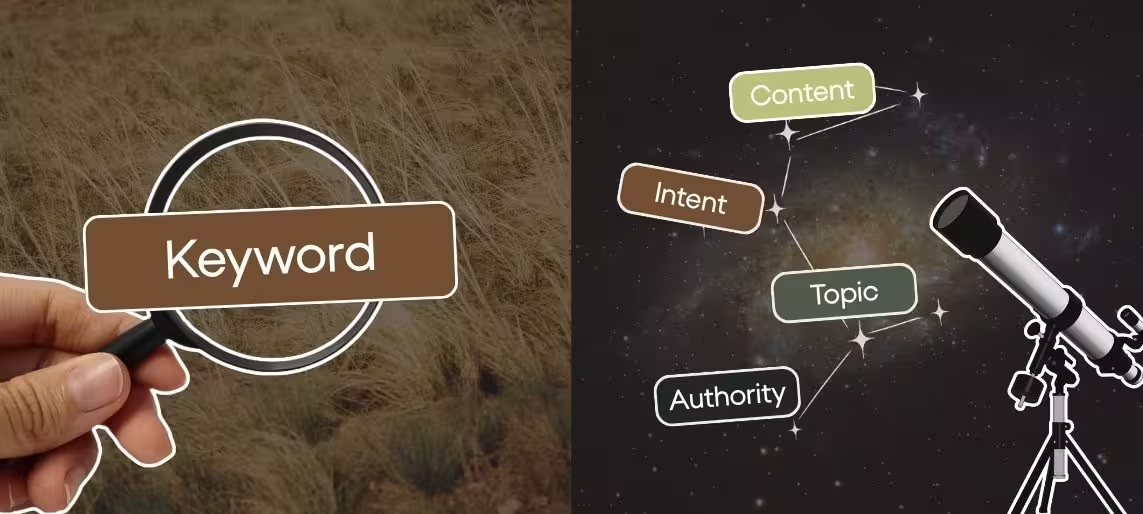
You’ve probably seen the headline by now: keywords are dead.
It shows up every time search changes. It happened after major Google updates. It happened again when search engines got better at understanding language. And now it’s happening with AI search.
The reality is keywords still matter, but not in the old way.
They still help search engines and AI systems understand what your content is about. They still reveal what your audience is searching for. What has changed is how much weight they carry on their own. Repeating an exact phrase is no longer the strategy. Covering the topic clearly, matching intent, and building authority matter far more.
In other words, in AI SEO, keywords matter less on their own than they used to, even though they still play an important role in relevance.
If your team is still treating SEO like a keyword-placement exercise, this is the moment to update that thinking.
Keywords were never the end goal. They were always a clue.
They helped marketers understand the language people used when they were trying to solve a problem, compare options, or learn something new. The issue is that SEO turned that clue into a formula. For years, brands chased exact-match phrases, density targets, and awkward wording because that used to help pages rank.
Search has moved on.
Today, search engines are much better at interpreting meaning, relationships between ideas, and the intent behind a query. AI-powered search adds another layer by summarizing information instead of only listing links.
That means a page does not win because it repeats one phrase more than everyone else. It wins because it helps the reader understand the topic, answers the question clearly, and shows enough depth for a search engine or AI system to trust it.
So yes, keywords still matter. They just matter as signals of relevance, not a script to force into every paragraph. That is one of the clearest shifts behind the idea that keywords matter less in AI SEO than they did in older search models.
AI search changed the way visibility works.
In traditional search, your goal was to rank well enough that someone would click your result. In AI search, your content may be used to help generate the answer itself. That changes the standard.
Your content now needs to be:
That is why vague writing struggles.
Let’s say someone searches: Do keywords still matter in AI search?
A weak article will dance around the answer, spend five paragraphs on background, and never say anything directly. A stronger article will answer immediately, explain why, and then expand with context.
That is the kind of structure AI systems can work with, and it also happens to be better for human readers.
AI search tools like ChatGPT, Perplexity, and Google’s AI-generated results are designed to synthesize information, not just retrieve it. They look for content that is easy to interpret and useful to reuse.
That usually means a few things.
If you ask a question in a heading, answer it right away in the first sentence or two below it.
That helps readers. It also helps AI systems identify the most relevant passage.
Loose, meandering writing is harder to extract from. Content works better when each section has one clear job and can stand on its own.
Good structure also improves your chances of showing up in summaries, featured snippets, and AI-generated responses.
AI systems are not only looking for one keyword. They are looking for whether the content covers the surrounding ideas that belong to the topic.
A strong page about keywords in AI search should naturally address search intent, topical authority, content structure, internal linking, and how AI systems interpret language. That is what complete coverage looks like.
Authority matters more now, not less.
If your site consistently publishes thoughtful content on a topic, uses clean structure, builds internal links between related pages, and demonstrates expertise over time, that gives search engines and AI systems more reason to rely on you.
The biggest mistake teams make right now is assuming the change is about abandoning keywords.
It is really about understanding why someone searched in the first place.
Take these two searches:
They are related, but they do not need the same content.
The first search comes from someone trying to understand a concept. The second comes from someone already thinking about execution. If you treat those as the same topic because they share similar wording, your content becomes less useful.
This is where strategy matters.
Good keyword research today is less about pulling a list of phrases and more about mapping questions, stages of awareness, and the decisions people are trying to make.
One of the clearest signs of this shift is the rise of conversational queries, where users ask full questions instead of typing short keyword phrases.
Keyword density used to be a common SEO obsession. Today, it is a distraction.
What matters more is whether your brand has built enough substance around a topic to be seen as credible.
That is where topical authority comes in.
Topical authority means you do not publish one article on a subject and move on. You build a connected body of content that explores the topic from different angles. You answer the basic questions, the advanced questions, the comparisons, the objections, and the implementation questions.
For example, if you want to own a topic like AI search optimization, one article is not enough. You also need supporting content around things like:
That is what signals depth.
This is also why keywords matter less in AI SEO when they are used in isolation. A single phrase cannot do the work that a strong content ecosystem does.
Instead of building one page around one phrase, modern SEO depends more on topic authority and how well your website covers a subject across connected content.
Yes.
You should still use keywords in your content because they help establish relevance. They help you align the page with real search demand. They also help clarify the topic for both readers and search systems.
What you do not need is forced repetition.
You do not need stiff sentences built around exact-match phrasing. You do not need to hit an arbitrary density target. And you do not need separate pages for every slight variation of the same idea.
A better approach looks like this:
That is a much healthier standard for both SEO and readability.
If your current approach is built on isolated keywords, it is worth reworking it now.
Start with topics, not just terms.
Look for the broader subject your audience is trying to understand, then map the real questions around it. Search suggestions, People Also Ask results, sales conversations, client calls, and content performance data can all help here.
Then build pages that answer those questions clearly.
For example, instead of creating thin posts for every keyword variation, create a strong core article and support it with related pieces that go deeper into the subtopics. That gives you better structure, stronger internal linking, and a more credible content ecosystem overall.
It also helps your content perform across more than one surface. Google search, AI-generated answers, voice search, and even social search all reward content that is clear, relevant, and well connected.
That is the bigger lesson for AI SEO: keywords matter less when treated as the whole strategy, and matter more when used as one signal within a stronger content system.
For teams with older keyword-focused content, a strong AI SEO content audit can help identify which pages need to be updated, expanded, consolidated, or restructured for modern search.
Yes, they do.
Keywords still matter because they help define relevance and reveal demand. They still play a role in how search systems interpret content. But they are no longer enough on their own, and they have not been enough for a while.
The content winning today is built around intent, structure, depth, and trust.
That is the real shift.
If your strategy still starts and ends with keyword placement, you are optimizing for an older version of search. If your strategy starts with what your audience is trying to understand and builds content that answers it clearly, you are much closer to how search works now.
And that is exactly where SEO and AEO start to overlap.
Yes. Keywords still matter because they help establish relevance and reflect what people are searching for. Their role is now part of a broader strategy that also includes intent, structure, authority, and content quality.
On their own, yes. AI search relies less on exact-match phrasing and more on meaning, context, and extractable answers. Keywords still help, but they are only one signal among many. In that sense, keywords matter less in AI SEO when they are not supported by depth and clarity.
Yes. Keyword research is still useful because it helps you understand audience demand, language patterns, and topic opportunities. The difference is that you should organize findings by topic and intent, not just individual phrases.
Topical authority, search intent, and content structure matter more than keyword density. Pages that answer questions clearly and cover a topic thoroughly are better positioned to perform in both traditional and AI-driven search.
Use them naturally in titles, headings, introductions, and relevant sections of the page. Then support them with related language, clear organization, and complete coverage of the topic.
Schedule a call with a marketing expert today to get started on your next phase of business.