SEO
Is AI Becoming the Next Major Sales Channel for Businesses?
Artificial intelligence has already transformed how people search for information. But a bigger shift is starting to take shape.
AI is beginning to influence how people make purchasing decisions.
Instead of simply directing users to websites, AI tools are starting to guide buyers through the entire decision-making process. People can ask questions, compare products, evaluate options, and in some cases even complete purchases without ever leaving the AI interface.
That shift means something important for businesses.
AI is no longer just a traffic source. It is becoming a sales channel.
Understanding this change is becoming critical for companies that want to stay competitive as the buying journey evolves.
In simple terms, yes. AI is rapidly becoming a new type of sales channel.
Platforms such as ChatGPT, Gemini, Perplexity, and Amazon’s Rufus are increasingly helping users move from discovery to decision without needing to visit multiple websites.
A user might ask a question such as:
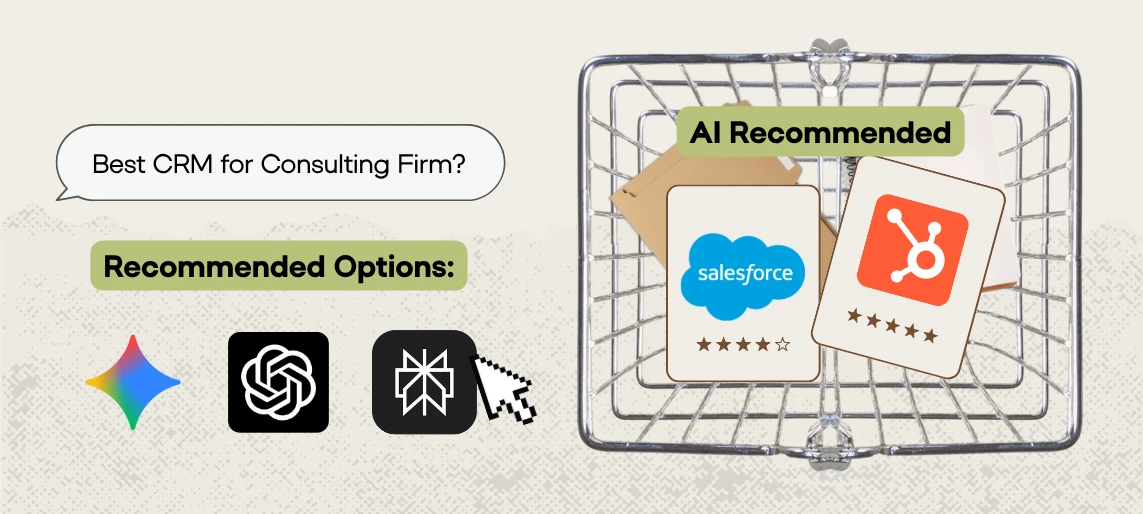
"What is the best CRM for a small consulting firm?"
Within seconds, the AI may provide a comparison of several platforms, highlight strengths and weaknesses, and recommend specific solutions.
From there, the user may ask follow-up questions about pricing, features, or integrations.
In some cases, the next step may involve booking a demo, purchasing a product, or contacting a provider directly from the AI interface.
This means the AI system itself becomes part of the sales journey.
Instead of acting only as a referral source, it becomes a decision layer between businesses and buyers.
To understand why AI is evolving into a sales channel, it helps to look at how people are already using it.
Many users now begin their research by asking AI tools for recommendations.
Instead of searching Google and reviewing ten different websites, they may ask an AI assistant questions like:
AI tools summarize options quickly and often provide structured comparisons.
Users can continue asking questions to narrow down their choices.
For example:
"What is the difference between HubSpot and Salesforce for small companies?"
"What CRM integrates best with QuickBooks?"
"What is the most affordable option?"
Each question moves the user closer to a decision.
In many cases, the buyer forms an opinion before ever visiting a company’s website.
This shift starts to resemble something businesses have seen before.
Over the last decade, new digital platforms have repeatedly become sales channels.
Amazon introduced the concept of the Buy Box, where product visibility directly influenced sales.
Social platforms later introduced their own shopping ecosystems.
Facebook Shops, Instagram Checkout, and TikTok Shop allowed users to discover products and purchase them without leaving the platform.
AI interfaces are beginning to operate in a similar way.
Instead of browsing through products manually, users ask questions and receive curated recommendations.
The AI acts as a guide through the buying journey.
In many cases, it presents a small set of recommended options rather than an endless list of search results.
This structure creates a powerful shift in how products and services are discovered.
This shift also supports the need for visibility across the broader search ecosystem, because AI tools may pull context from search engines, social platforms, review sites, forums, and industry content.
Traditionally, the buying journey followed a fairly predictable pattern.
A user searched for a problem. They reviewed search results. They visited websites. Eventually they compared options and made a decision.
AI compresses that entire process.
A single conversation can move through multiple stages of the buying journey in minutes.
A user might begin by asking a general question such as:
"What is the best email marketing platform?"
The AI provides several options.
The user then asks:
"What is the easiest one to use?"
"What does it cost?"
"Which one works best for small businesses?"
Within a few questions, the AI has essentially recreated the product comparison stage of the buying process.
This conversational flow accelerates decision-making.
If AI becomes the first place people ask for recommendations, the implications for businesses are significant.
Traditionally, companies focused on improving their website rankings.
The goal was to appear as high as possible in search results.
But if a buyer receives recommendations directly from an AI assistant, the number of options presented may be very small.
Instead of ten search results, the AI might highlight three or four solutions.
That means visibility inside AI responses becomes extremely valuable.
Businesses that are recognized by AI systems as credible solutions may be recommended repeatedly.
Those that are not may never appear in the conversation.
AI systems do not select recommendations randomly.
They analyze a wide range of signals to determine which companies or solutions appear credible and relevant.
These signals often include:
AI systems look for patterns across many sources.
If a brand appears consistently in credible discussions about a topic, the AI becomes more confident recommending it.
In other words, AI systems attempt to determine which companies appear to be legitimate experts in their field.
Why Traditional Websites Are No Longer the First Conversion Layer
For many years, the company website served as the central conversion layer.
Traffic arrived through search engines, social media, or advertising. Once users reached the website, they evaluated products and decided whether to convert.
AI disrupts that model.
A buyer may form strong opinions before visiting any website.
They may already know which brands they are considering and which options they have eliminated.
By the time they click through to a website, the decision process may already be far along.
In some cases, the website may only serve as the final step for completing a purchase or requesting a demo.
This changes the role of websites within the broader sales process.
Instead of acting as the primary discovery engine, they become one component of a larger ecosystem where AI plays a major role.
If AI tools are becoming part of the buying journey, then businesses need to understand how to optimize for AI recommendations so they are more likely to appear when users ask for solutions. AI systems also often look beyond your website, which means brand mentions and industry recognition can influence whether your business appears as a credible recommendation.
AI platforms gather information from a wide range of sources.
These sources often include websites, product documentation, reviews, discussion forums, industry publications, and structured data about companies and products.
The AI analyzes patterns across these sources to understand which companies appear credible within a given category.
This means a company’s visibility is influenced not just by its own website, but by how it appears across the broader digital landscape.
Consistent messaging, clear expertise, and credible references help AI systems understand where a brand fits within a market.
When that information is fragmented or unclear, AI may struggle to identify the brand as a strong recommendation.
Businesses that want to benefit from AI as a sales channel need to think about visibility differently.
Instead of focusing only on traditional search rankings, they need to consider how their expertise and offerings appear across multiple platforms.
Clear positioning becomes important.
AI systems must be able to understand what a company does, who it serves, and what problems it solves.
Consistent content also helps.
Publishing authoritative insights around a topic helps reinforce the company’s expertise in that area.
When the same themes appear repeatedly across credible sources, AI systems gain confidence in associating the brand with those topics.
Companies that want to prepare for this shift should start by examining how their brand appears across the web.
Is the company clearly associated with specific topics or expertise?
Do credible sources mention the brand in relevant discussions?
Is the value proposition easy for both humans and AI systems to understand?
These questions help determine whether a brand is positioned to appear in AI recommendations.
Businesses should also pay attention to the platforms where AI tools gather information.
Industry publications, credible blogs, product documentation, and authoritative resources all contribute to how AI systems interpret a company’s expertise.
As AI continues to evolve, visibility across these environments will likely play an increasing role in how companies are discovered.
The most important takeaway is that AI is changing how buyers discover and evaluate solutions.
For many users, AI tools are becoming the first place they ask questions.
That means these platforms influence which products and services enter the conversation.
Businesses that treat AI purely as a traffic source may miss the larger opportunity.
AI is becoming something much bigger.
It is emerging as a new type of sales channel.
Schedule a call with a marketing expert today to get started on your next phase of business.